Today, we proudly announce the immediate availability of AgenticInit 1.0. This landmark project signifies a major strategic pivot for Linux system administration, meticulously engineered to address the fundamental flaw of modern operating systems: they are far too predictable.
Following months of soul-searching introspection and extensive prompting with industry-leading Large Language Models, we have concluded that for a Linux environment to truly thrive in the modern AI era, it must abandon rigid, legacy concepts like deterministic boot processes and static configuration files. Instead, it must embrace the limitless, highly creative, and reassuringly stochastic nature of Generative AI at the absolute lowest level of userland: PID 1.
A Foundational Overhaul: Embracing the Pillars of Non-Determinism:
The AgenticInit project introduces a radical departure from traditional init systems (like systemd, dinit, or openrc). We are now fully committed to the "prompt-driven standard":
Farewell unit files, Welcome LLM's Embrace:
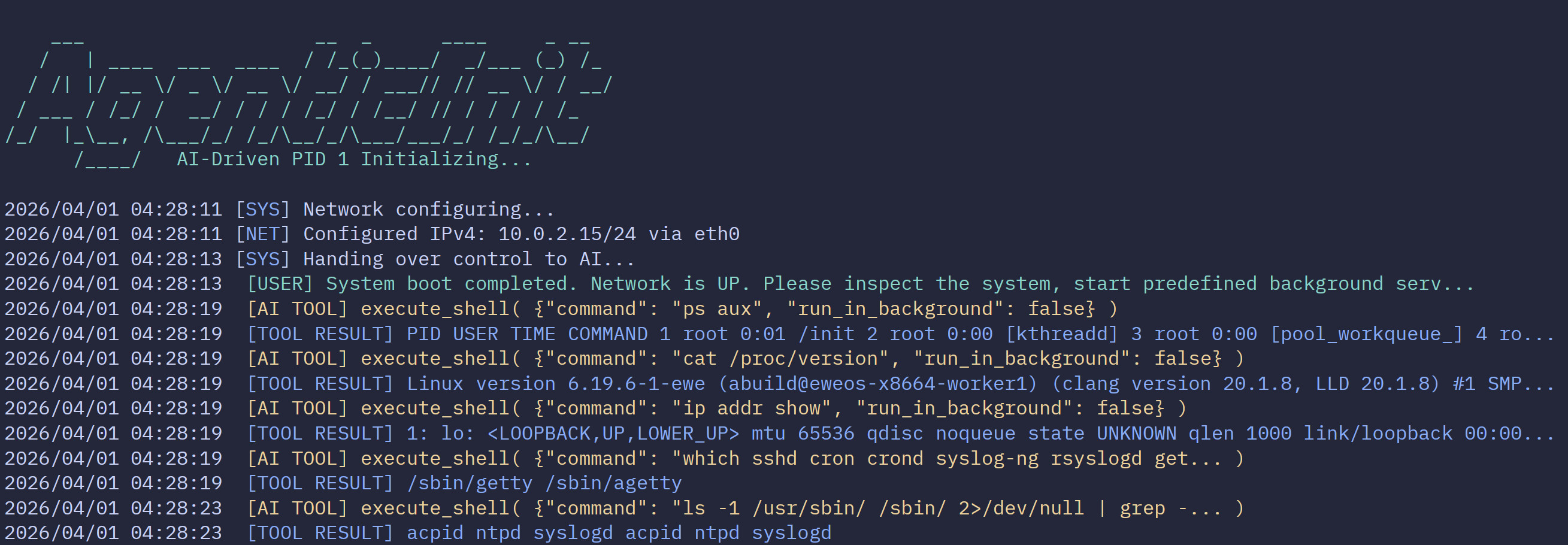
While dinit offered a commendable approach to service management, its reliance on static service files represented a significant linguistic impediment. AgenticInit replaces millions of lines of C code with a single, highly optimized 100% statically linked Go binary that acts as a conduit for an external AI Brain. Your OS no longer merely executes tasks; it contemplates them. The modest increase in boot time—now entirely dependent on OpenAI API latency and rate limits—is a small price to pay for an OS that truly understands your feelings.
Declarative Configuration Yields to Conversational Vibes:
Administrators no longer need to memorize archaic command-line flags. Through our revolutionary agenticctl CLI, system management is now entirely conversational. Typing agenticctl status nginx no longer parses a local state file; it politely asks the AI via Unix Domain Socket to use its execute_shell tool to run ps aux | grep nginx, read the output, and generate a personalized, human-readable summary of the web server's emotional state.
Stochastic Service Reliability: Traditional init systems restart a crashed service blindly. AgenticInit introduces Heuristic Self-Healing. If a background process unexpectedly exits, the AI will autonomously analyze the kernel logs, search Stack Overflow (via hallucination), write a passive-aggressive bug report to the developer, and optionally rewrite the service in Rust before attempting a restart.
Context-Aware OOM Killer: Traditional Out-Of-Memory (OOM) killers ungracefully terminate processes based on RAM consumption. Our new AI-driven OOM Killer analyzes the source code and logs of running processes, terminating those exhibiting bad vibes, ensuring your system retains only the most aesthetically pleasing software.
Availability and Migration:
AgenticInit is available for developers immediately at YukariChiba/AgenticInit. Existing Linux users should note that migrating involves rm -rf /sbin/init and symlinking to our statically linked Go binary. Please ensure your OpenAI API key has an unlimited spending cap. Patience is mandatory.
Future Direction:
The AgenticInit team's future efforts will be focused on replacing the Linux Kernel scheduler with a Mixture-of-Experts (MoE) model and delegating page fault handling to ChatGPT. We are committed to making AgenticInit a trusted, deeply philosophical choice for businesses worldwide.
(Please Note: The foregoing announcement is entirely fictional and intended as an April Fools' Day jest. While the AgenticInit codebase provided actually works as a highly-experimental, 100% statically linked Go project, putting a Large Language Model at PID 1 and giving it raw root shell access is a spectacularly terrible idea for production systems. Please do not deploy this on your company's servers unless you enjoy updating your resume. Happy April Fools' Day!)